


|
|
|
|
|
This allows the allocation of a payment to a particular invoice/s. The advantage of allocating a payment to the correct invoice or credit note is that the Creditors Trial Balance report will show the correct aging balances, and also, the remaining invoices owing will correspond with the supplier’s monthly statement.
After details of the payment have been entered (using the guidelines set out in the section "Entering a Supplier Payment) the option is available to Allocate by clicking on the "Allocate" button, or to use the [shift F9] key. This will have the effect of automatically allocating the total of that payment from the top line down.
(NB. The default setting in Concord for sorting the invoice table, is in Tax Invoice order).
This option is suitable for use if the Supplier Payment is paying all outstanding invoices shown on the table.
If not, and specific invoices are required to be selected for allocation, double click on the relevant lines. If the payment and the allocation totals match correctly, there will be a zero balance showing in the Allocate: $ , as demonstrated in the diagram below. If there is a discrepancy, the figure will appear and the allocation will be unable to be processed.
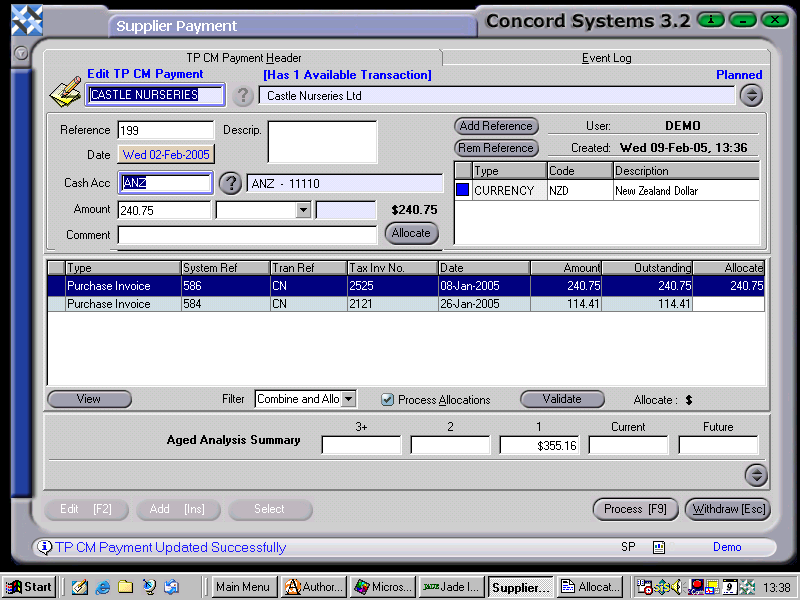
Once the transaction is ready to be processed [F9], it is recommended that the allocations be validated, by clicking on the Validate button. The Process Allocation button should be ticked, otherwise the planned allocations will be deleted.
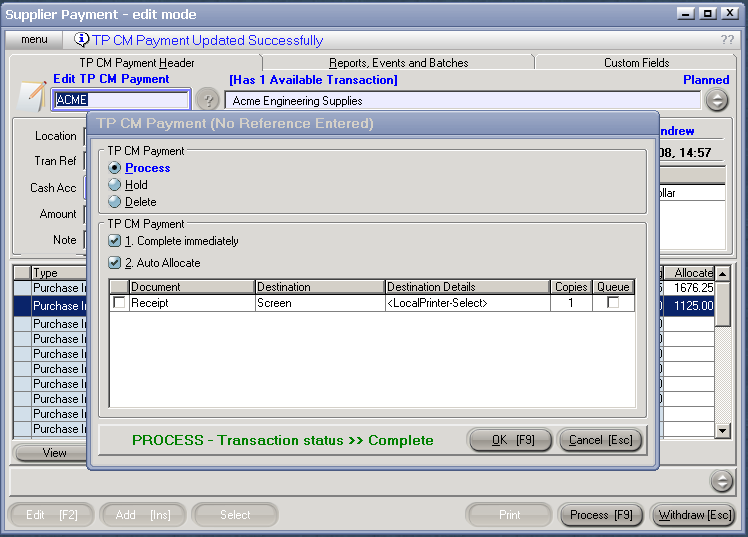
After selecting the [F9] Process button, ensure that the Auto Allocate button is selected, otherwise the allocations will not be processed.
The payment will now be reflected in the supplier’s balance owing, and the payment amount and date is shown on the <SM> Supplier Maintenance details screen. The payment has also been sent directly to the bank statement <BS> function, enabling it to be reconciled.